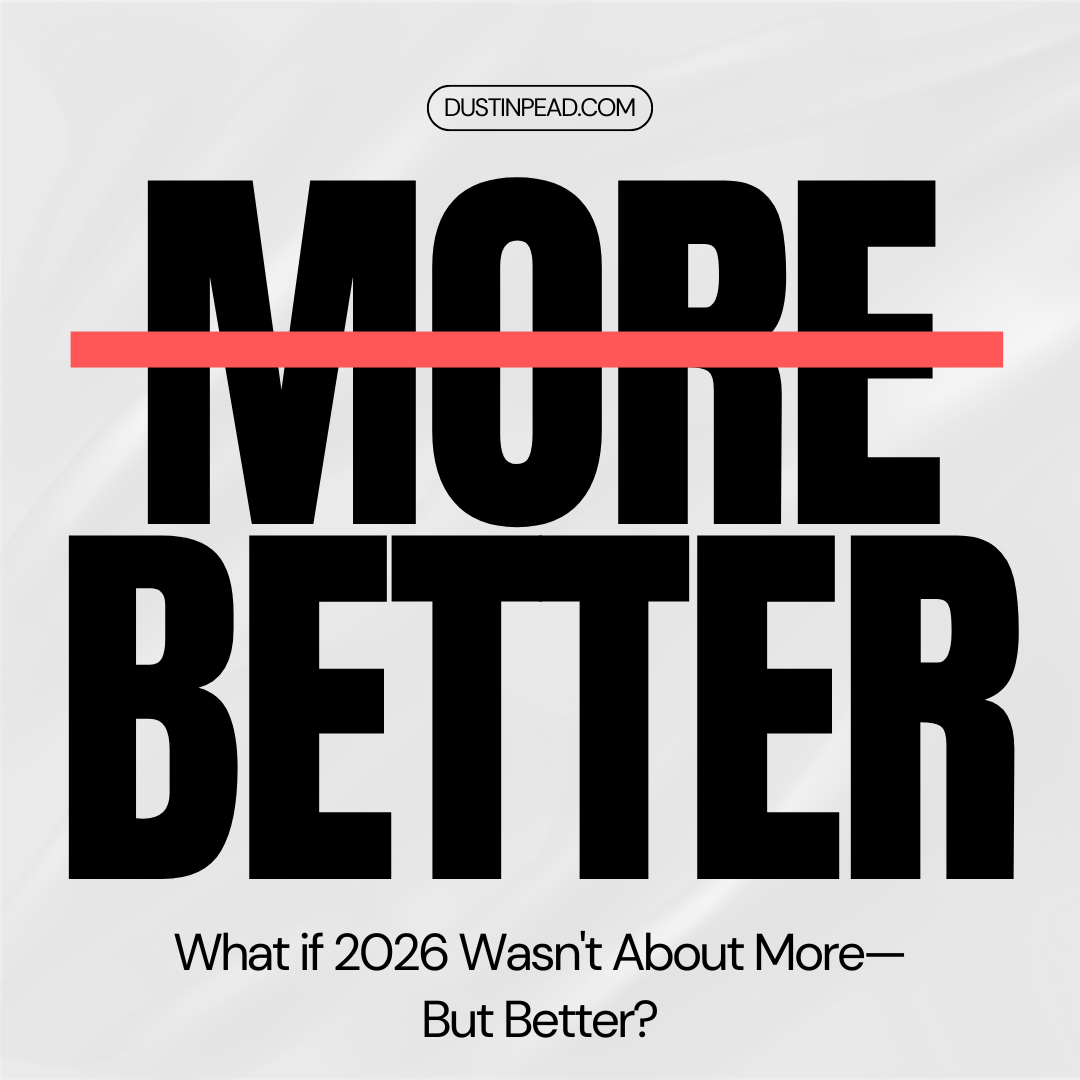
What if 2026 Wasn't About More—But Better?
It's happening again.
I'm seeing it in discovery calls, in Slack messages, in the energy my clients bring to coaching sessions as we head into December. That familiar restlessness. The shiny object syndrome. The ambitious declarations about what 2026 is going to be.
More clients. More services. More team members. More revenue. More, more, more.
And I get it. I really do.
Because here's what's driving it: You saw another creative agency launch a new service line that's crushing it. You noticed someone's follower count exploded. You watched a competitor upgrade their gear and their entire brand presence. And suddenly, your carefully-built business doesn't feel like enough.
The comparison trap is real, and it's especially vicious for creative professionals.
The Problem with More
When I started Chief Creative Consultants, I did something that felt completely wrong at the time: I only gained one new client in my entire first year.
One.
While other consultants were talking about their packed client rosters and their waitlists and their team expansion, I was serving one client. Showing up every week. Building systems. Refining my frameworks. Learning what actually worked versus what sounded good in theory.
It felt slow. It felt small. It felt like I was missing opportunities.
But here's what I learned: Being faithful in those "little things"—serving that one client with excellence, developing my process, building sustainable systems—taught me everything I needed to know to serve other clients well.
I didn't learn how to scale by scaling. I learned it by going deep first.
What "Better" Actually Means
When I talk about "better" instead of "more," I'm not talking about playing small or settling for mediocrity. (That would completely violate my Excellence value.)
I'm talking about:
Better systems that create margin instead of chaos
Better clients who value your work and pay appropriately
Better margins that fund creativity instead of constant firefighting
Better team dynamics that multiply your capacity
And here's the counterintuitive truth that surprises every client who makes this shift:
Better actually equals more.
Better systems = more peace.
Better margins = more creativity.
Better clients = more meaningful, ongoing work.
Better team = more capacity without burning out.
You get the "more" you actually wanted—but it's sustainable.
A Practical Example
Let me make this concrete. If you're a creative agency with 10 people, here's what "better" looks like in 2026:
Focus more on your team than your product offerings.
I know this feels backwards. Most agency owners are constantly thinking about new services they could offer, new niches they could serve, new ways to package their work.
But here's the reality: Your team has to execute everything you dream up. And they might know things about what it actually takes that you don't as the leader.
Team development always pays more dividends than being product-focused because:
They'll execute your existing services more efficiently
They'll identify process improvements you're missing
They'll attract better clients through excellent work
They'll stick around instead of burning out
This is what capacity management is really about—knowing your actual capacity to deliver excellence, not just your theoretical capacity to take on work.
The Stakes Are Real
I've watched what happens when creative professionals keep choosing "more":
More burnout.
More team members leaving.
More headaches that pull you away from actual creative work.
More revenue that doesn't translate to more peace.
But when someone chooses "better"?
Increased creativity. Better team morale. Stronger collaboration. Deeper client relationships.
The business metrics improve too—but as a byproduct of doing the right things well, not as the primary driver.
Over the next few weeks, I'm going to challenge some of the assumptions most creative professionals bring into a new year. On December 9th, I'll show you why the best creative leaders plan in December (not January). And from December 14-25, I'm running "The 12 Days of Creative Clarity"—daily posts on building a sustainable 2026.
But it starts here, with this question: What if 2026 wasn't about more, but better?
What would change if you believed that?